
Beaufort County Previous Residents Sources
The useful sources for previous residents of a Beaufort County address overlap, but they do not cover the same years or answer the same question. Begin with the address’s current parcel and legal description, then use the deed sequence to move from one owner to another. A directory or census entry can support a household lead for a dated interval, while an obituary or estate file can help close a trail. The County does not publish a definitive earliest complete online deed-index year or verified directory-volume inventory, so system dates and collection limits need to remain part of the result.
| Source | Verified era or limit | Where held | Address-history value |
|---|---|---|---|
| Neumo ROD search | Converted and current from 02/23/2026 | Register of Deeds online | Current recorded-document search |
| Legacy New Vision and INDEX books | Legacy through 02/19/2026; no earliest complete index date published | ROD online or counter | Older party, book, page, document, and handwritten-index research |
| Old plats | Book A and 3 through 76 online; some books counter only; Book 78 from 02/02/2001 in property search | Register of Deeds | Lot, block, subdivision, and road context |
| Beaufort District Collection | Scope 1752 to present; exact directory runs unpublished | Library local-history collection | Maps, microfilm, and confirmed directory leads |
| Library obituary index | 1862 to about 1992 | Library and BDC | Death, family, and newspaper lead |
| Federal census | Released through 1950 | Archives and library databases | Household snapshot for its census date |
| May 1894 Sanborn map | Four Beaufort sheets | Library of Congress | Building and street context, not names |
For a recent owner transfer, start with the parcel and ROD. For an old household question, take the parcel details first, then ask the Beaufort District Collection for confirmed material from the needed period. The source sequence matters because an owner is not automatically an occupant, and a historical address entry is not automatically proof of title.
Beaufort County Parcel Starting Point
Past residents are best traced from a parcel rather than from a current street string. In the Beaufort County GIS map, look up the full address or use the address-search option of number plus street name plus % when a broader documented match is needed. The selected result can lead to real-property information. Record the PIN or DMP, the situs address, owner, mailing address, acreage or class, legal-description language, and a map or plat reference before moving backward.
Those details survive changes that can break a plain address search. A current address may describe a divided tract, a multi-unit parcel, or a place whose jurisdiction differs from its postal name. The County Real Property Lookup is an official route, although the archive view did not respond during research. GIS, the current Real Property Information system, and the Assessor’s 843-255-2400 contact provide documented alternatives. Separate situs and mailing addresses in the research notes. Mailing data is correspondence information, not proof that the listed owner lived on the parcel.
Beaufort County Previous Deed Chain
The backward deed chain is the core ownership trail for previous residents research. The Beaufort County Register of Deeds Official Records Search supports a search term, recorded-date range, and index or full-text scope. Search the current owner as a grantee, or use a subdivision, document number, or legal details from the parcel. Open the acquisition deed and identify the grantor, the person or entity transferring the property. Search that grantor as a grantee to find the earlier acquisition, then repeat. Compare the legal description each time rather than trusting a street name alone.
- Capture the current PIN or DMP, legal description, parcel address, and named owner from GIS or real-property records.
- Find the latest acquisition deed by the owner or the stable land details, then save the document number, recorded date, party roles, and plat or lot references.
- Take the seller or grantor from that deed and search the same person or entity as a grantee for the previous purchase.
- At every step, compare acreage, subdivision, lot, block, map reference, and legal description. Trusts, estates, married names, and entities can create a false break.
- When an older result disappears from one search, use the legacy system, its INDEX path, old plats, and the ROD counter before concluding the chain has ended.
- Grantor
- The party transferring an interest in a recorded deed. In a backward chain, that seller is often the next name to research as an earlier buyer.
- Grantee
- The party receiving the interest. A current owner’s acquisition deed normally lists that person or entity as grantee.
- Chain of title
- The sequence of recorded transfers for the same land. It is a research trail, not a substitute for professional title work.
- Legal description
- The recorded land wording, such as lot, block, subdivision, town, or map reference. It is more durable than a street address when the address changes.
Beaufort County ROD Cutover
A two-system check is essential for a Beaufort County deed trail. The County identifies Neumo as converted and current from 02/23/2026 and New Vision as legacy through 02/19/2026. The transition does not define the age of the property or prove a gap in title. It means a title search that spans the cutover should check both locations. The County’s ROD instructions describe legacy Browser View routes for Name, Book/Page, Document Type, Town/Lot/Block, and Map Number searches.
For handwritten grantor/grantee and mortgagor/mortgagee index books, use Document Type, expand All, select INDEX, and search in the legacy system. That documented route is more reliable than assuming every older entry will appear in a modern keyword search. Keep a source log showing the system searched, spelling used, date range, result number, and any document or book/page reference.
A screenshot of the County’s ROD software-upgrade notice records the 2026 transition that makes the cross-search necessary.
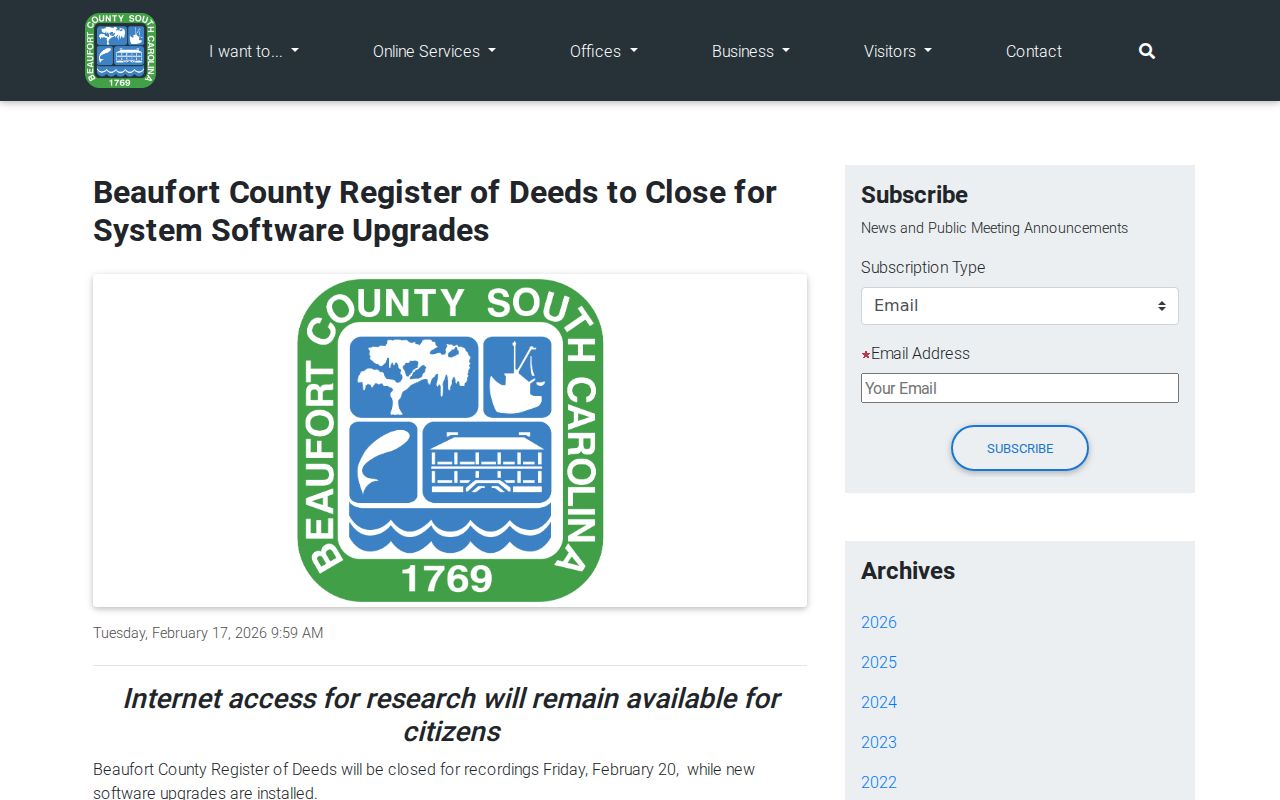
The vendor change is a search-routing fact. It does not assure that every older document is fully digitized, indexed, or available online.
Beaufort County Old Plats
A plat often bridges the gap between an old address and a durable legal description. The ROD old-plats archive converts microfilm from Plat Book A and Books 3 through 76. Books 1, 2, 27, 47, and 77 require office contact, while Book 78 from 02/02/2001 forward is in the property-records search. A plat can explain a subdivision, lot, block, road arrangement, or tract boundary that a deed describes only in abbreviated terms.
Several plats can share a page number, and suffix letters distinguish images. Review the full page sequence. If the tract was later divided, compare the older acreage, bounds, and plat reference before assigning a former household to a modern lot number. The ROD requires District, Map & Parcel information on deeds and plats, so the DMP is a practical connection among old deeds, tax material, and County databases.
Note: A recorded plat provides land context and adjoining geometry, but it does not identify a current or historical household on its own.
Beaufort County Address Era Map
Build an era map before calling a gap a dead end. The ROD systems and plats form the land layer. The Beaufort District Collection may have local maps, microfilm, confirmed directories, or newspapers for a later household layer. The library’s obituary index covers more than 24,000 local-news death entries from 1862 to about 1992. DPH historical death indexes cover 1915 through 1967, and the federal census is released through 1950. Each can point to a different date in the history of the same place.
Write the trail as a simple sequence: current parcel and legal description → newest acquisition deed → earlier acquisition deeds → confirmed local directory or newspaper lead → census household snapshot → obituary or probate endpoint. A source may place a person near an address without proving ownership. Conversely, a deed can prove a recorded transaction but not every person who stayed there. The strength of the file comes from documenting which source supports which part of the history.
Beaufort County Directory Census Pairing
The Beaufort District Collection is the right local contact for a possible historical directory, reverse or criss-cross directory, telephone book, newspaper microfilm, or house-history source. Its public pages do not list exact local directory years, publishers, or reverse-directory runs. Ask staff to confirm the source before stating that a particular year exists. The collection is at 311 Scott Street, recommends appointments, and its broader library research service notes that Ancestry Library Edition is available on library computers or Wi-Fi rather than at home.
- Provide BDC with the person, approximate year, community, address variants, and a request for a specific directory or newspaper type.
- Save the confirmed volume year, page, address spelling, and every abbreviation used in the local entry. Do not assume another city’s format applies.
- Compare that date with the applicable released federal census household. The 1950 census is the newest released population census at the research date.
- Return to the deed chain and plat reference to determine whether the household lead relates to the same parcel, tract, or later subdivision.
- Use an obituary, probate file, or State Archives source only as support appropriate to its date and record type.
The Beaufort County city directory page concentrates on the local collections themselves. Previous residents research uses them as a time-stamped household layer after the land trail is established, rather than as a substitute for a parcel or deed check.
Beaufort County Sanborn Context
The Library of Congress May 1894 Beaufort Sanborn map has four sheets that provide a structure and street-context snapshot. It may show that a mapped building or street arrangement existed at that time. It does not name every person who lived there. Use it to test whether a modern address wording fits the historic landscape, then return to deeds, confirmed directories, census material, or newspaper sources for people-related evidence.
The County’s 1998 Above Ground Historic Resources Survey offers another address-linked lead for unincorporated County and Port Royal resources. It can include a historic name, date, community, address, city, and PID for surveyed properties. Its documented coverage excludes the City of Beaufort because of technical complications. For a historic city address, route the search to City sources, BDC, Sanborn material, and recorded land records instead of claiming the County survey covers it.
Beaufort County Historic Jurisdictions
Older Beaufort County research has a boundary-history problem that can affect both people and property records. The area was administered from Colleton and then Granville before the later county arrangement, and early official records were kept in Charleston. Coastal administration also used the St. Helena, St. Luke’s, and Prince William’s parishes. In 1769, Beaufort District covered territory now associated with Beaufort, Hampton, and Jasper counties. A missing search result under the modern county name therefore is not proof that no older record exists.
Western parts of Beaufort County formed Hampton County in 1878, and Jasper County emerged in 1912 from parts of Hampton and Beaufort. Record the historical jurisdiction beside each older address, tract, person, and source citation. For Reconstruction-era family history, the South Carolina Department of Archives and History is an additional channel for county microfilm, census material, and related collections. Its African American genealogy guide identifies Beaufort and Charleston Freedmen’s Bureau marriage and divorce records for 1866 to 1868 and Freedmen’s Savings Bank registers for 1865 to 1874, which can contain family or prior-residence leads.
Beaufort County Past Household Ends
Obituaries and probate files can help close the trail when a former resident died at or after leaving an address. The Beaufort County Library obituary index is an index, not a complete digitized newspaper collection. It can offer a name, death date, relatives, funeral information, or a later place to verify. Ask BDC for a copy or source citation, then compare it with a probate estate, recorded deed, death index, or census record. Probate may identify a deceased person, personal representative, heirs, property, and timing, subject to the normal access limits of court files.
A screenshot of the Beaufort County Probate Court shows the official office that administers estate matters and keeps its court records in Beaufort.
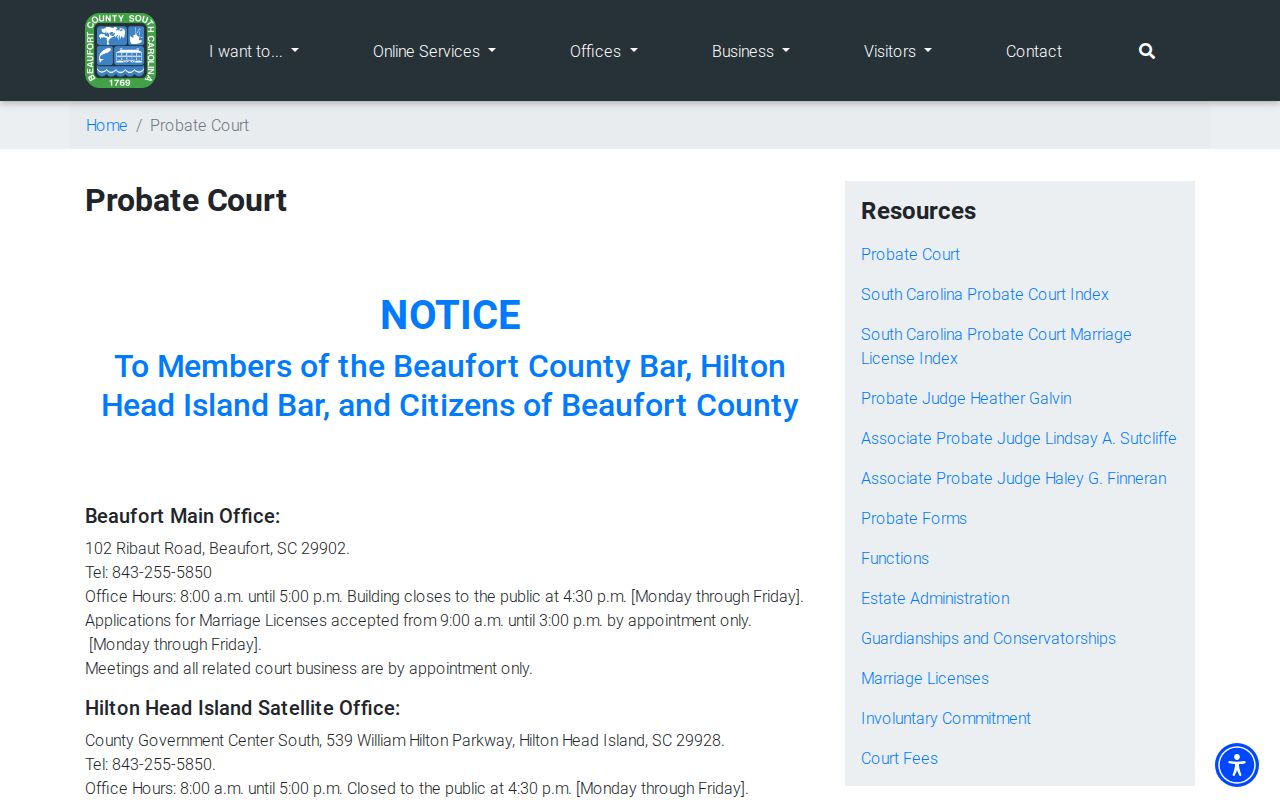
Probate has main, Hilton Head, and Bluffton offices, but the County says court records are kept in Beaufort and satellite filings can be couriered, which may delay them. Use a court file to corroborate a dated estate connection, not to infer every person who occupied a property.